
.svg)
.svg)
Fractional CMO vs marketing agency vs in-house: a cost framework for startups


You need marketing leadership. But choosing between a fractional CMO and a marketing agency can feel paralyzing. A fractional CMO may bill $3,000 to $6,000 per month for 10 to 20 hours. Agencies often ask for $5,000 to $10,000 monthly retainers. A full-time marketing hire can cost $120,000 or more per year. That’s before you know what actually works.
Here's the problem: every option feels either too expensive or too risky for your stage. Meanwhile, founders with strong personal brands see 3-7x higher conversion rates compared to traditional corporate marketing. The opportunity cost of waiting isn't zero.
This post explains when each execution model makes sense. It also shows what each really costs, including hidden operational overhead. It covers where traditional options fail for resource-constrained startups.
The real cost of marketing execution models
Most founders compare sticker prices: fractional CMO hourly rates vs agency retainers vs full-time salaries. That's incomplete math. The real cost includes coordination overhead, context-sharing time, and the mental load of managing external partners.
Understanding fractional CMO cost, marketing agency retainer structures, and in-house marketing vs agency trade-offs requires looking beyond invoices to operational reality.
Fractional CMO: $3,000-6,000 monthly plus management overhead
Fractional CMOs typically bill $150-300/hour with 10-20 hour monthly minimums. That's $3,000-6,000 in direct fractional CMO cost. But here's what the invoice doesn't show:
- You spend 3-5 hours monthly in briefings, status calls, and context-sharing
- Every strategy deck requires your review
- Every recommendation needs your approval
Founders typically spend 23+ minutes refocusing after each content review cycle. At 4-6 review cycles monthly, that's 2-3 hours of fragmented attention on top of the retainer. GrowTal's analysis shows fractional marketing leaders can cut costs by 50–80% versus full-time hires. They still need active management.
The coordination tax is real. You become the connective tissue between the fractional CMO and your product roadmap, customer feedback, and sales pipeline.
Agency retainers: $5,000-10,000 monthly plus coordination tax
Personal branding agencies charge $2,000-8,000+ monthly for executive branding packages. Marketing agency retainer costs start at $5,000-10,000 for comprehensive services. The coordination tax is even higher than fractional setups:
- Weekly briefings
- Approval workflows
- Constant context-sharing about product updates, customer feedback, and competitive moves
Agencies require you to be their project manager. They don't embed in your tools or workflows. Every piece of context lives in your head. Extracting it becomes a second job. Similar coordination challenges appear when agencies manage freelancer costs, where the 80-hour freelancer actually costs 120 hours after management overhead.
In-house marketing: $120,000+ annually plus onboarding lag
Full-time marketing hires cost $120,000-180,000 in salary alone when evaluating in-house marketing vs agency options. Add benefits, equipment, and recruiting costs. Year-one total cost hits $802,500 when factoring all overhead. The bigger problem: 3-6 month ramp time before they're productive. You won't know if the hire works until month 9-12.
For pre-Series A companies, that timeline risk is existential. Your startup marketing budget can't absorb a 12-month experiment that fails. You need results in 90 days, not 9 months.

Why traditional models break down for early-stage startups
The execution models above weren't designed for resource-constrained founders. They were built for companies with dedicated marketing budgets, established processes, and teams to manage external partners.
The operational overhead problem
Every external partner requires active management, whether fractional or agency. You become the bottleneck: briefing them on product changes, reviewing their work, providing feedback, answering questions. The very activities you hired them to eliminate become your new full-time job.
ReachSocial data shows thought leadership delivers 156% ROI versus 9% for traditional B2B marketing. But capturing that advantage requires consistency, not sporadic execution managed around a founder's schedule.
The same operational dynamics play out across knowledge work. Fractional CTO engagements compress AI deployment timelines from 11–13 months to 2–3 months. They do this by cutting coordination overhead between strategy and execution.
The consistency gap
Agencies and fractional leaders provide strategy and campaigns. What they don't provide: daily execution infrastructure. Professionals with strong personal brands see 2.4x more connection requests and 8x more engagement on their content. Those outcomes require posting 3-5 times weekly for 90+ days. Traditional models don't solve for that cadence.
Most founders choose between expensive agency retainers or doing nothing. They miss the compounding growth opportunity that systematic execution creates. The personal branding agency cost of $2,000-8,000 monthly assumes you need strategic consulting, not execution infrastructure.
The decision framework by company stage
Here's when each model makes sense:
Pre-product-market-fit (seed stage)
You can't afford the operational overhead of managing external partners. Your startup marketing budget won't stretch to $5,000-10,000 monthly retainers plus your management time. You need automated execution that doesn't require daily input. Tools that connect directly to your business context (CRM, support tickets, product updates) eliminate briefing cycles.
Scaling with proven messaging (Series A)
Agencies and fractional leaders add strategic value when you know what works and need to scale it. The coordination overhead is worth it because you're optimizing proven channels, not experimenting. At this stage, a fractional CMO costs $3,000 to $6,000 per month. It delivers clear ROI because you are refining execution, not discovering messaging.
Enterprise-stage with complex campaigns (Series B+)
In-house makes sense when you're running multi-channel campaigns that require daily coordination. The management overhead is acceptable because you have the infrastructure to support it. The in-house marketing vs. agency choice favors in-house when campaigns are too complex for outside partners to manage.
For most early-stage founders, the answer isn't which traditional model to choose. It's recognizing that traditional models weren't built for your constraints. Similar architectural decisions appear in beauty startup planning, where eliminating upfront costs changes what's operationally possible.
What to do next
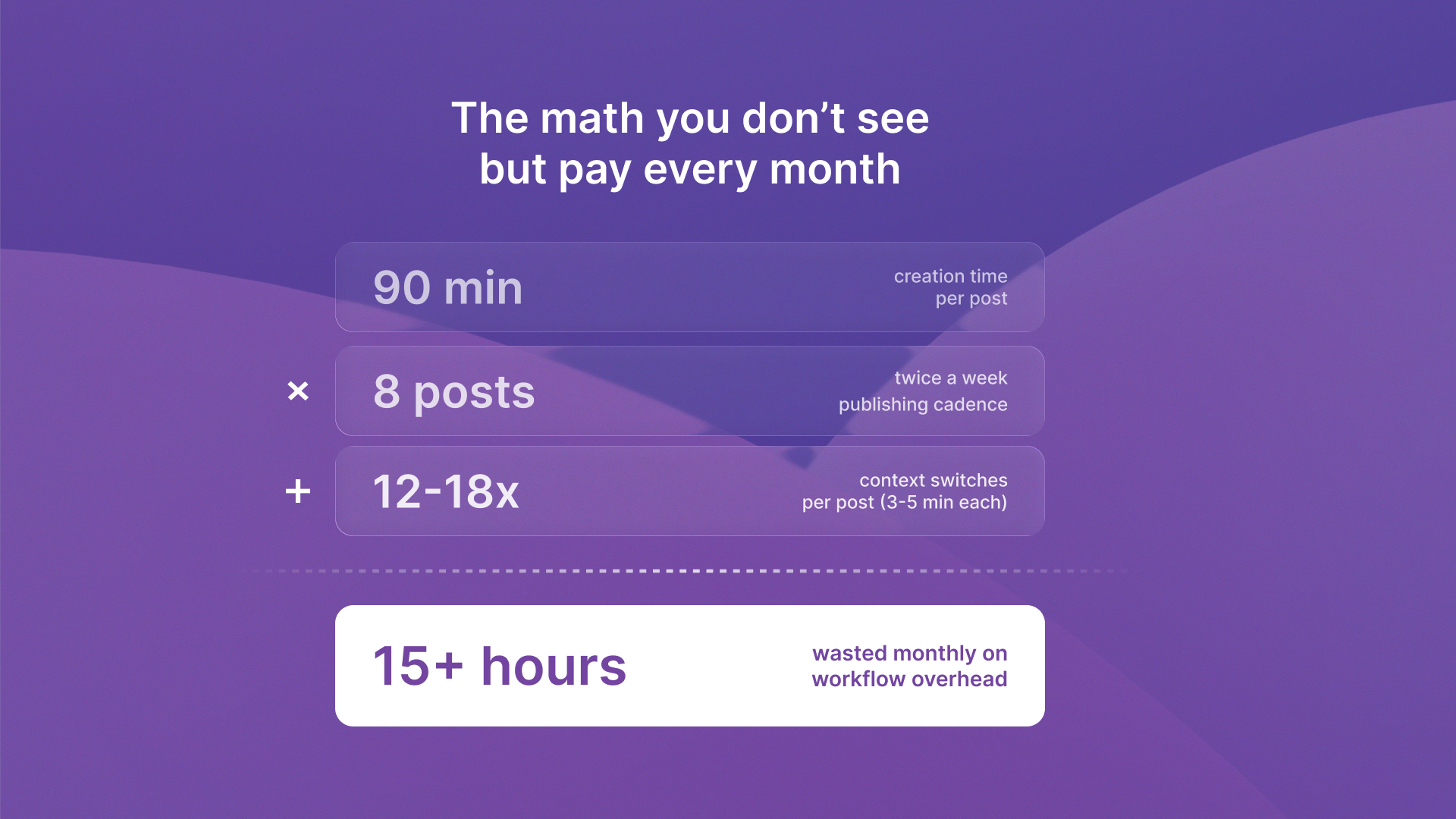
Calculate your true marketing execution cost including coordination time. If you're spending 5+ hours monthly managing external partners, that's 60+ hours annually at your hourly rate. Add that to the retainer for honest cost comparison.
Identify whether you need strategy or execution. Most early-stage founders need execution consistency, not strategic consulting. If you know what to say but struggle to say it consistently, strategy isn't your bottleneck. The same pattern appears in hiring decisions: knowing which problem to solve determines which solution makes sense.
Test automated execution for 90 days before committing to agency retainers. Platforms like ReachSocial deliver agency-level LinkedIn content automation at $99/month, a 95%+ cost reduction while maintaining consistency. Similar automation advantages appear in QA testing, where autonomous systems eliminate the hiring bottleneck.
Track content consistency as the leading indicator, not vanity metrics. Publishing 12-16 posts monthly for 90 days compounds into measurable pipeline impact. Sporadic execution, regardless of quality, doesn't.
The goal isn't finding the cheapest option. It's finding the execution model that doesn't require you to have a second job managing your marketing. Ready to build consistent execution without the coordination overhead? Start automating your LinkedIn content today.


.png)



%2520(14).png)
.png)
%2520(13).png)