
.svg)
.svg)
How to build a linkedin content calendar that eliminates weekly scramble

.png)
You know you should post on LinkedIn consistently. You've read the advice. You've seen the results others get. But here you are again: Monday morning, staring at a blank screen, wondering what to write about this week.
The guilt cycle repeats: plan to post, forget, throw together something generic on Friday. This isn't a motivation problem or a creativity problem. It's a system problem. Most LinkedIn advice tells you what to post or how to write hooks. But it skips the operational layer: how do you actually plan 30 days of content without making it a part-time job?
The solution is a repeatable content planning system. It converts one focused session into a month of consistent content. Here's how to build it.
Why inconsistent posting compounds your disadvantage
Sporadic posting trains LinkedIn's algorithm that you're unreliable. Accounts that did not post during a given week grew more slowly than usual. This was true across all platforms (Buffer State of Social Media Engagement 2026). When you disappear for a week, the algorithm reduces your distribution even when you do return.
The pattern creates a downward spiral:
- You post less
- Your reach drops
- You feel discouraged
- You post even less
Breaking this cycle requires removing the friction that causes gaps in the first place.
The shift from inspiration to system
Brands increased posting frequency over 2025. Image posts rose from 5 to 7 monthly. Video doubled from 2 to 4 posts (Social Insider LinkedIn Benchmarks 2026). This increase is sustainable only with planning systems, not motivation.
Successful LinkedIn presence requires increasing your LinkedIn posting schedule through systematic planning. Don't wait for inspiration. The professionals posting 3-4 times per week aren't more creative than you. They have a schedule that removes decision-making from the daily workflow.
Building a social media content calendar takes the same strategic work. It is the work that content strategy consultants bring to brand authority projects. The difference is you're applying it to your own LinkedIn presence instead of waiting for creative lightning to strike.
How to build a 30-day planning calendar for LinkedIn consistency
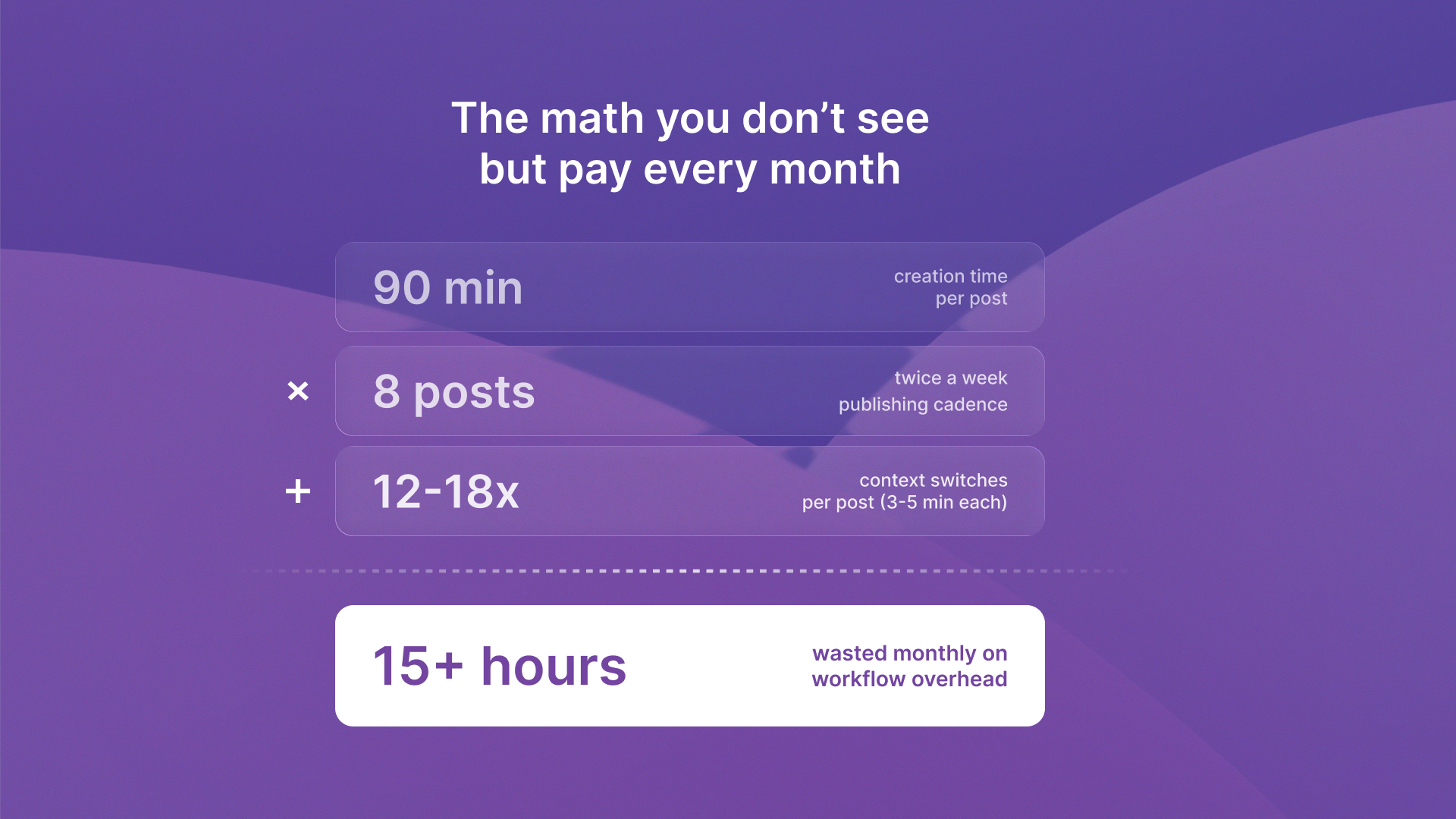
A 30-day planning calendar converts one strategic session into four weeks of execution without daily creative decisions. Planning in batches reduces decision fatigue and context-switching costs. When you plan 12-16 posts in one session, you eliminate the cognitive load of starting from scratch 12-16 separate times.
Start with theme rotation
A rotating framework of 4-5 content themes creates variety without requiring infinite ideation. Choose themes that match your expertise and audience needs:
- Tactical how-tos (step-by-step guides for solving specific problems)
- Industry observations (what you're noticing in your market)
- Contrarian takes (challenging common assumptions in your space)
- Case studies (real examples from your work or research)
- Personal lessons (what you've learned through experience)
This framework provides natural variety. It also constrains the infinite possibility space that causes decision paralysis. You're not deciding what to write about from scratch. You're deciding which theme to address next in your rotation.
Build your content backlog
Dedicate two hours to populating a content backlog. Open a document and brainstorm 20-30 specific post ideas across your themes. Don't write the posts yet. Just capture the core concept:
- How to audit your LinkedIn profile in 15 minutes
- Why most B2B content strategies fail before launch
- The email template that doubled our response rate
- What we learned spending $50K on LinkedIn ads
The backlog eliminates blank-page paralysis. You're never starting from zero because you already know what you're writing about. Tools like ReachSocial help professionals plan campaigns and track results. Your main asset is a backlog of proven ideas.
Schedule your planning session
Block 90 minutes at the end of each month for batch planning. During this session:
- Review your backlog and select 12-16 post ideas for the next 30 days
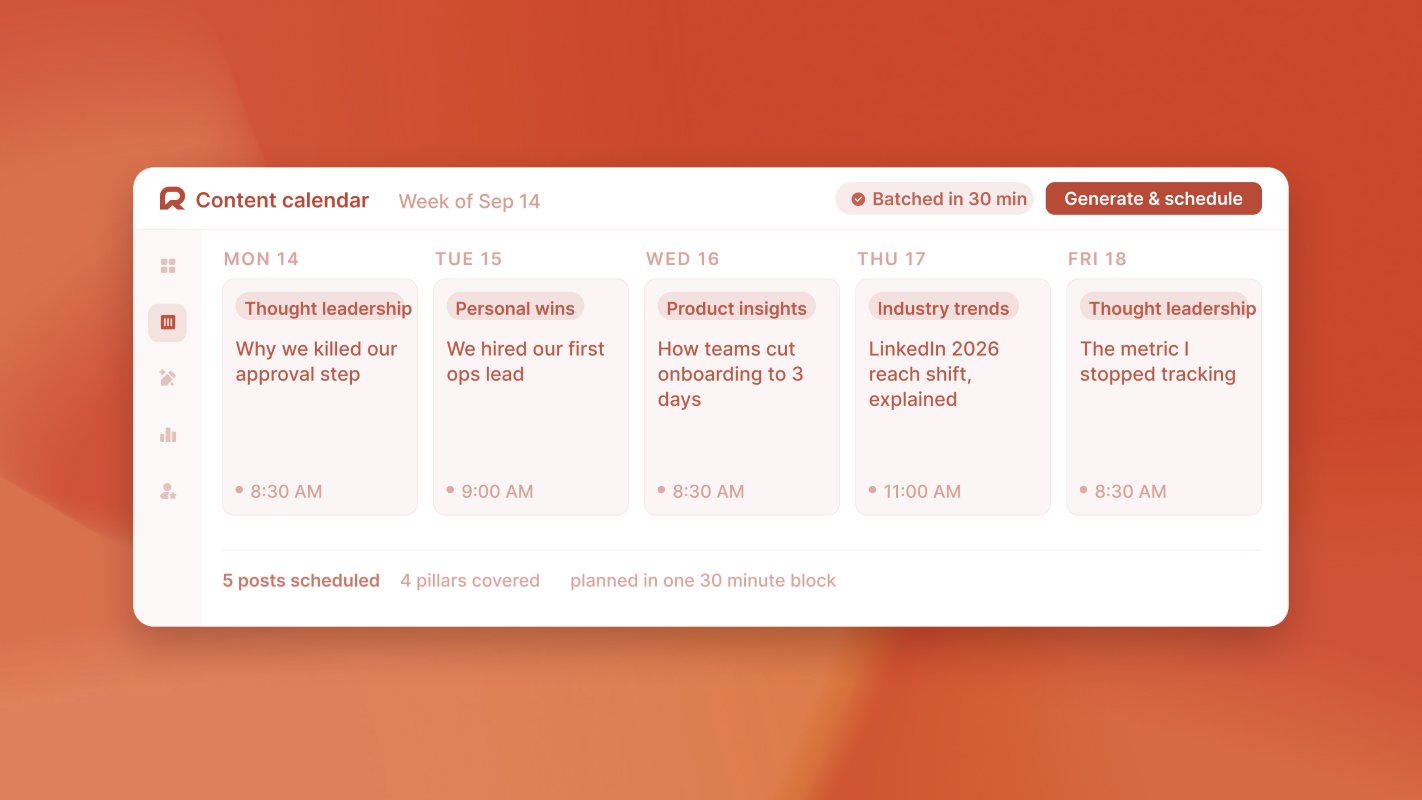
- Map them to a calendar with specific publish dates
- Draft 4-6 posts immediately while you're in writing mode
- Leave the remaining slots as concepts (you'll write them in smaller batches)
This hybrid approach gives you momentum without requiring a marathon writing session. You enter the month with a clear roadmap and several posts ready to go. The same strategic thinking that GTM strategy consultants use for market entry works here.Batch your strategic decisions. Then execute them step by step.
Execute in weekly batches
Each Monday, spend 30-45 minutes writing the remaining posts for that week. You already know what you're writing (it's in your calendar), so you're just executing. The decision is made. The creative paralysis is gone. You show up, write, schedule, and move on.
This weekly rhythm maintains consistency without treating content as a daily creative challenge. Most professionals can sustain 30-45 minutes of focused writing once per week. Few can sustain daily spontaneous creation.
.png)
What this system eliminates
A 30-day planning system removes three friction points that kill consistency:
- Decision fatigue: You're not choosing topics every time you sit down to write
- Context switching: You batch similar work instead of interrupting your week with random posts
- Momentum loss: You always know what's next, so you never lose forward progress
The system works because it converts a recurring high-friction task into a low-friction routine. Instead of figuring out what to post and writing it each time, you execute against a plan you already made.
This approach is very valuable for teams at growth marketing platforms. Resources are limited, and every founder or operator hour must drive compounding returns. Your LinkedIn presence becomes a systematic growth channel instead of an energy drain.
Build the system once, use it forever
A 30-day planning system isn't about being rigidly scheduled or losing spontaneity. It's about eliminating the weekly scramble so you can show up consistently without burning out. Plan in batches, rotate themes, build from a backlog, and let the system do the heavy lifting.
LinkedIn consistency compounds. The question isn't whether you have good ideas. It's whether you have a system that captures them and puts them to work.
Ready to end the Monday morning content scramble? Block 90 minutes this week to build your content backlog and plan your first 30 days of LinkedIn posts.



%2520(14).png)
.png)
%2520(13).png)