
.svg)
.svg)
Why thought leadership ROI beats traditional marketing by 16x


Traditional B2B marketing delivers 9% ROI. Thought leadership delivers 156%. That’s not a rounding error. It’s a fundamentally different economic model. Most executive teams are leaving it on the table.
The gap exists because these strategies operate on different timeframes and create different types of value. Traditional marketing creates one-time transactions. Thought leadership builds compounding credibility assets that generate returns over 12-24 month periods. When measured properly, thought leadership ROI becomes the highest-performing investment category in B2B marketing. Yet most companies still underinvest because they measure it with the wrong frameworks.
The 16x thought leadership ROI gap is structural, not accidental
The IBM Institute for Business Value 2025 study measured what executives believed but could not prove. It found that thought leadership delivers 156% average ROI. Traditional B2B marketing delivers 9% average ROI. The gap widens as buyer sophistication increases.
Promotional marketing buys attention through ads, events, and outbound campaigns. Each dollar spent generates a single impression or interaction. Thought leadership creates content assets that attract compounding inbound interest over time. A piece of authoritative content published today continues generating leads, shortening sales cycles, and influencing deals 18 months later.
The returns compound because credibility builds on itself. When prospects discover your content during research, they arrive at sales conversations already convinced of your expertise. Deal velocity increases. Win rates improve. Contract values grow because buyers perceive less risk. Content strategy consultants who focus on B2B thought leadership measurement report strong results. Clients see 3-5x higher close rates when buyers read several content pieces before entering the pipeline.
The measurement problem hiding the returns
Most companies fail to capture this content marketing ROI because they measure thought leadership with demand gen metrics. They track MQLs, click-through rates, and form fills. These are metrics designed for short-cycle transactional marketing. The impact remains invisible in standard marketing dashboards.
According to the TopRank Marketing and Ascend2 B2B Thought Leadership Report 2026, 97% of B2B marketers now consider thought leadership critical throughout the entire funnel, not just top-of-funnel awareness. That's up from 73% in 2023. The recognition is spreading, but the measurement frameworks haven't caught up.
Companies that reach the 156% ROI benchmark use multi-touch attribution. It links content use to faster deals, larger contracts, and shorter sales cycles. They track:
- How many times a prospect engaged with thought leadership content before entering the pipeline
- Whether deals close faster when multiple buying committee members consume the content
- Win rates on deals where content played a role versus deals where it didn't
Similar measurement discipline appears in business cases that survive board scrutiny where executives connect strategic initiatives directly to revenue outcomes.
Building a measurement framework for thought leadership vs traditional marketing
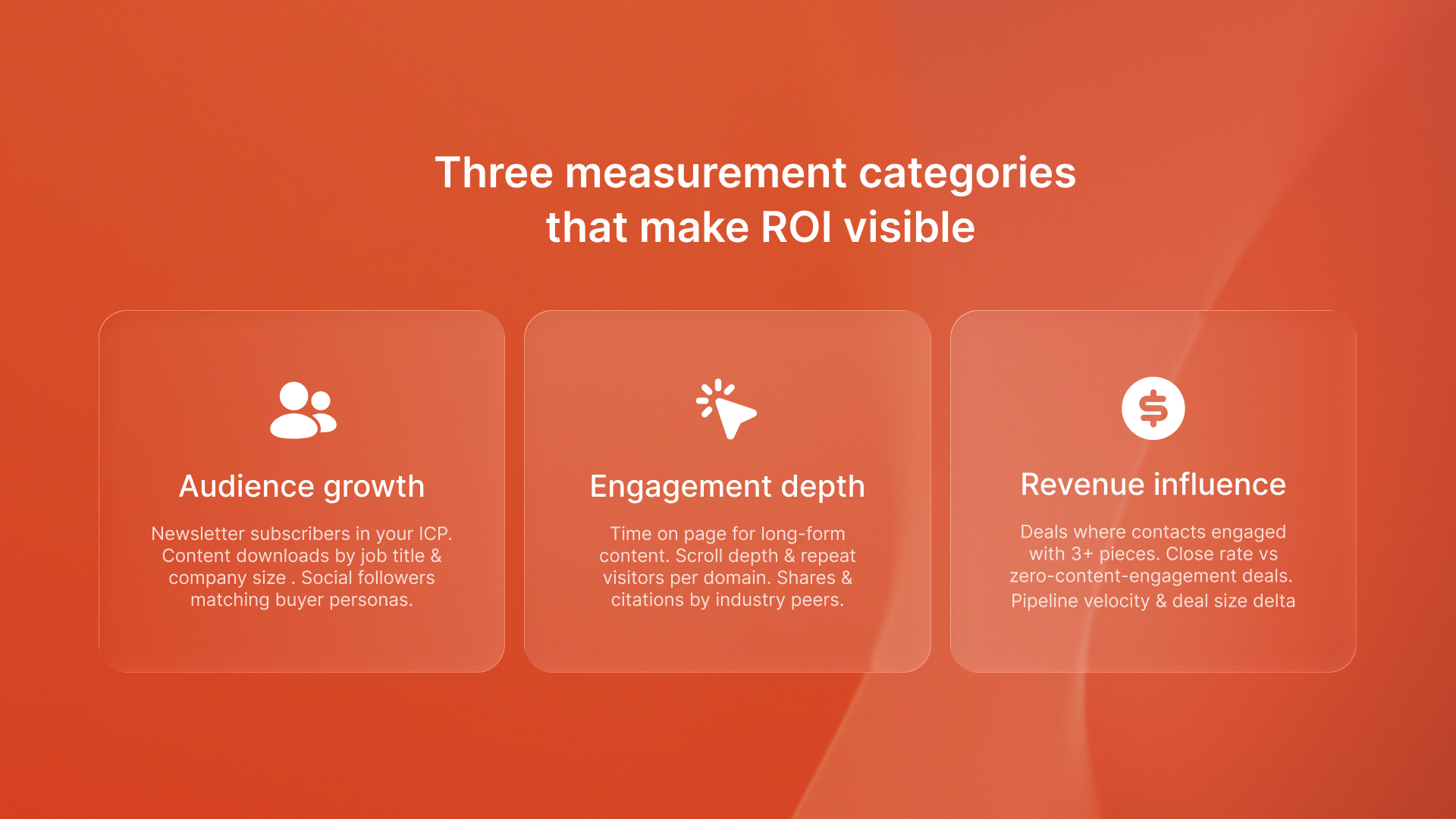
Measuring thought leadership impact requires tracking three distinct categories. Each has different benchmarks depending on maturity stage.
Audience growth metrics
Audience growth metrics measure whether you're building reach with the right people. Track newsletter subscribers in your ICP. Track content downloads by job title and company size. Track social followers that match buyer personas. Early-stage programs should see 15-20% monthly growth. Mature programs maintain 5-8% growth with higher quality audiences. GTM strategy consultants use these metrics to validate whether content reaches decision-makers versus random traffic.
Engagement depth signals
Engagement depth signals go beyond surface-level metrics like page views. Track time on page. Aim for 3+ minutes on long-form content. Track scroll depth. Aim for 75%+ completion. Track repeat visitors who read multiple pieces. When the same domain returns to read five different articles, that signals genuine interest, not random traffic. Measure content shares and citations by industry peers. Thought leadership spreads through networks when it contains genuinely useful insights. Track how often your content gets referenced in competitor analysis, industry reports, or peer discussions.
Revenue influence indicators
Revenue influence indicators make thought leadership ROI quantifiable. Track deals where contacts engaged with 3+ pieces of content versus deals with zero content engagement. Measure the difference in close rates, deal size, and sales cycle length between these groups. Monitor pipeline velocity for contacts who downloaded gated content versus those who didn't. Calculate the revenue value of opportunities where multiple buying committee members consumed thought leadership content. These indicators connect content directly to revenue outcomes in ways that justify budget allocation to finance teams. B2B SaaS SEO consultants tracking organic content performance see similar attribution challenges when connecting search traffic to closed revenue.
Why most thought leadership programs fail before production
The pattern mirrors what happens in enterprise technology initiatives. 95% of enterprise AI pilots fail before production because teams optimize for proof-of-concept metrics instead of production performance. Thought leadership programs fail for the same reason.
Executives greenlight a pilot program. The team produces content. They measure MQLs and click-through rates because those metrics are easy to track. The numbers look mediocre compared to paid campaigns. The program gets defunded before compounding returns accumulate.
The companies that succeed treat thought leadership as a 12-24 month investment cycle, not a quarterly campaign. They build measurement systems that track deal influence, not just lead generation. They give content assets time to rank in search, get found by researching buyers, and shape purchase decisions over long B2B sales cycles.
The strategic choice and its consequences
Thought leadership isn't a brand luxury. It's the highest-ROI marketing investment in B2B when measured properly. The measurement challenge is real. It requires different frameworks than demand gen, longer attribution windows, and executive patience to let compounding returns accumulate.
Companies that build thought leadership systems with clear attribution will gain lasting advantages. Competitors may still focus on MQLs and impressions. The content they publish today becomes an asset generating returns for years. The credibility they build creates pricing power and competitive insulation that paid campaigns can't match.
The gap between 156% ROI and 9% ROI represents strategic choices about where to allocate budget and executive time. One approach buys temporary attention. The other builds lasting authority. The long-term consequences of that choice compound just like the returns.
Ready to shift budget from temporary attention to lasting authority? Start by implementing multi-touch attribution that connects your content directly to revenue outcomes.



.png)



%2520(14).png)
.png)
%2520(13).png)