
.svg)
.svg)
Linkedin consistency fails when workflows demand too many decisions

%2520(14).png)
Most LinkedIn advice tells you to "just post more." The problem isn't your motivation. It's that your content workflow requires too many decisions, too many tools, and too much manual work to sustain.
You know LinkedIn content matters. You've tried to post consistently. You've failed, not once, but multiple times. The prevailing narrative blames lack of discipline or commitment. The real culprit is operational friction. Your workflow makes you switch between 3-4 different tools. You must make dozens of small decisions. You also have to copy and paste content across platforms. This isn't a content problem or a motivation problem. It's a systems problem.
The operational overhead killing your consistency
Content creation fails when operational overhead is too high, not because people lack ideas or motivation. Companies using automated workflows complete operations 10-20x faster than those doing everything manually. Switching between ChatGPT for drafting, Google Docs for editing, and Buffer for scheduling adds friction. That extra effort creates mental strain and breaks consistency before motivation becomes an issue.
%20(17).png)
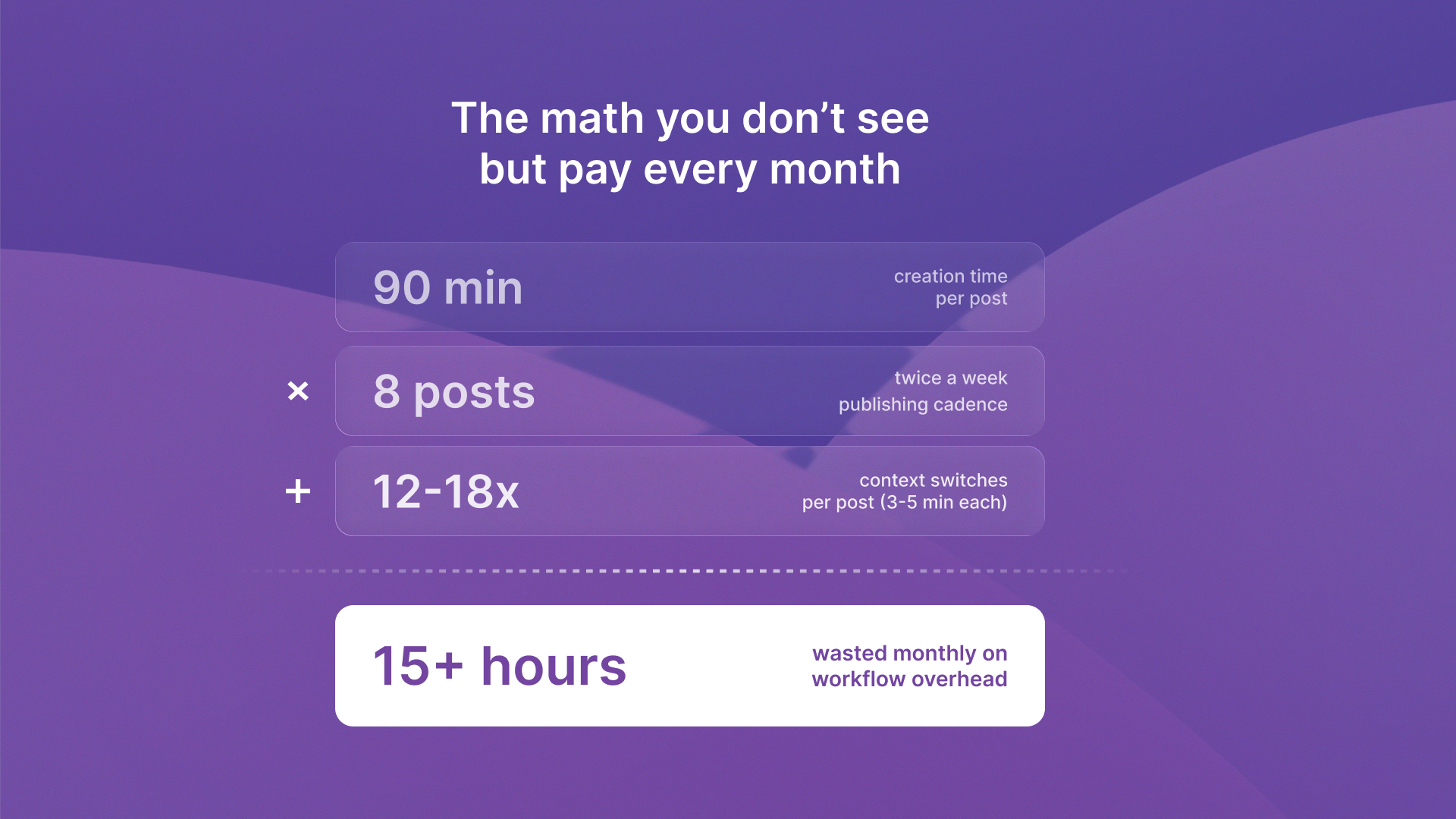
The typical LinkedIn workflow causes 4 to 5 context switches per post. You ideate in a notes app. You draft in ChatGPT. You edit in Google Docs. You schedule in Buffer. Then you manually copy and paste. Each switch introduces friction, decision fatigue, and opportunities to abandon the process mid-stream. This is the tool-switching tax, and it invisibly drains time while creating failure points at every transition.
The friction audit
Count the number of tool switches and manual steps required to publish one post. That number is your friction score and your opportunity to reclaim hours per week through better operational design. Most LinkedIn workflows score 8-12 friction points. A consolidated LinkedIn content system can reduce that to 2-3.
Here's what to count:
- Every time you open a new tool or platform
- Every manual copy-paste action between tools
- Every formatting adjustment you make more than once
- Every decision about where to save, edit, or schedule content
Each friction point represents cognitive overhead that compounds over time. When you map your current workflow, the waste becomes visible and addressable.
Why automation compounds your productivity
Average productivity increases of 25-30% occur in automated processes. When used for content creation, this can save hours each week. Those hours can go back into the business. Or you can post more often without spending more time. The gains grow over time because less friction lowers the effort needed to start each post, not just finish it.
Posting at least once a week on LinkedIn can increase profile views by up to 4x and double your followers. The operational challenge is building a system that makes consistent LinkedIn posting sustainable without requiring constant willpower or decision-making. When the workflow demands less cognitive overhead, consistency becomes the default state rather than an achievement.
What sustainable posting looks like
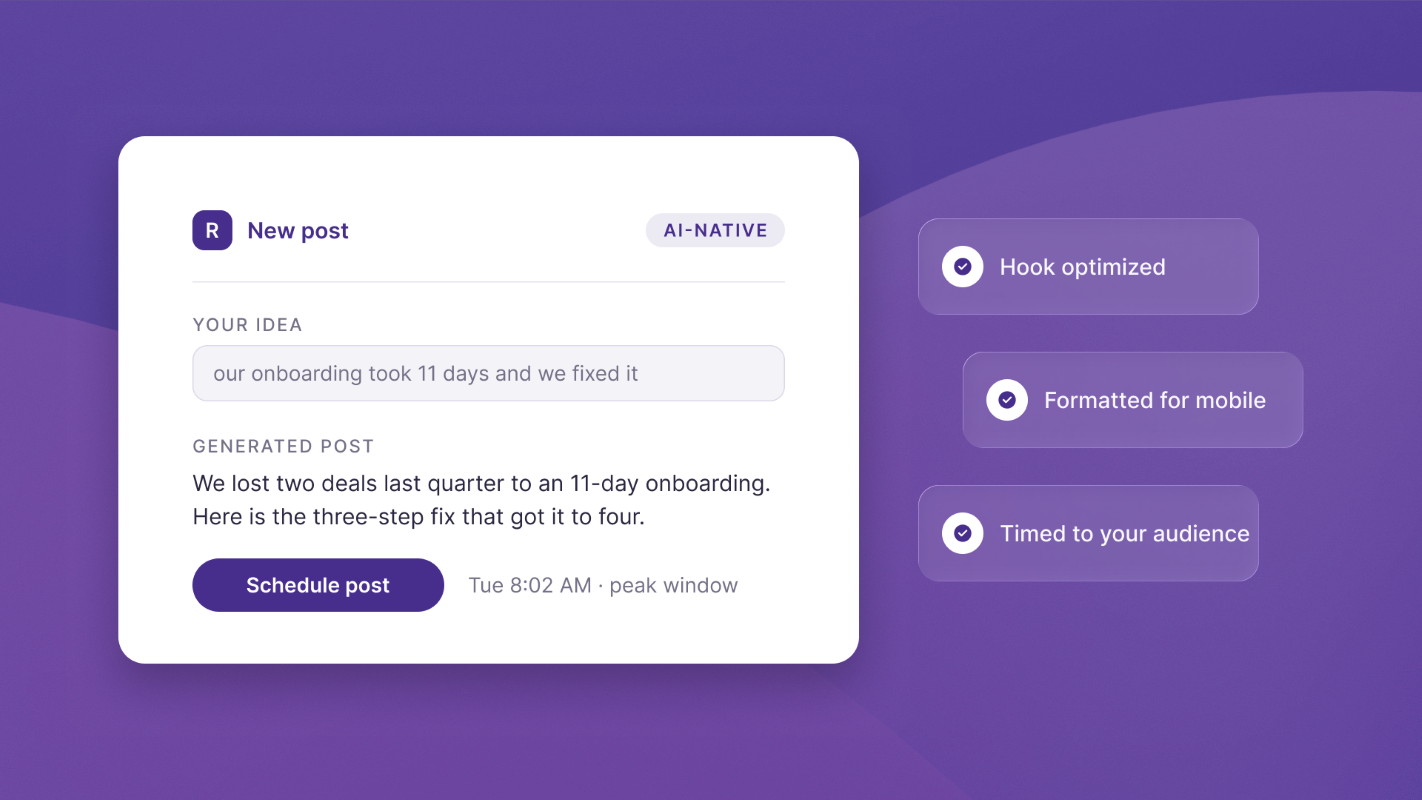
Posting becomes sustainable not because you've found more willpower, but because you've removed the friction that was draining it. When writing, editing, and scheduling happen in one place with little context switching, the workflow stays consistent. The question shifts from “How do I stay motivated?” to “How do I build a system that works without motivation?”
sustainable content operations require consolidated workflows, not motivational speeches. The path to LinkedIn posting consistency runs through operational design, not productivity hacks.
Systems thinking reframes the problem
When content consistency is treated as an operational challenge, solutions become concrete: consolidate tools, reduce decision points, automate repetitive steps, and create forcing functions. This is the same systems thinking that drives operational efficiency in other parts of the business. The businesses winning on LinkedIn in 2026 won't be the ones who hustle harder. They'll be the ones who build better systems.
Operational design beats willpower every time. A well-designed workflow removes the micro-decisions that drain motivation: where to draft, how to format, when to schedule, which platform to use. Each eliminated decision point preserves cognitive resources for the creative work that actually matters. The goal isn't to automate creativity but to automate everything around it so creativity can flow without interruption.
.png)
The GrowTal blog covers how fractional marketing professionals approach this same operational design challenge across channels and content types. The pattern holds: systems win when willpower fails.
What to do next
Audit your current workflow: Count every tool switch, manual copy-paste, and decision point between idea and published post. Write down each step.
Identify consolidation opportunities: Which steps could happen in fewer tools? Where are you switching contexts unnecessarily? What manual work could be automated?
Start with one improvement: Pick the highest-friction step and eliminate it. Don't rebuild everything at once. If scheduling requires three clicks and two tool switches, start there.
Explore operational support: If building a sustainable LinkedIn strategy feels overwhelming right now, consider working with marketing professionals. They specialize in designing content creation systems.
Sometimes the fastest path to consistency is letting experts handle the operational architecture.
LinkedIn consistency fails because we treat it as a motivation challenge when it's actually an operational design problem. When you consolidate your workflow, reduce decision points, and automate repetitive steps, posting becomes sustainable. Not because you've found more willpower, but because you've removed the friction that was draining it.


.png)



.png)
%2520(13).png)